
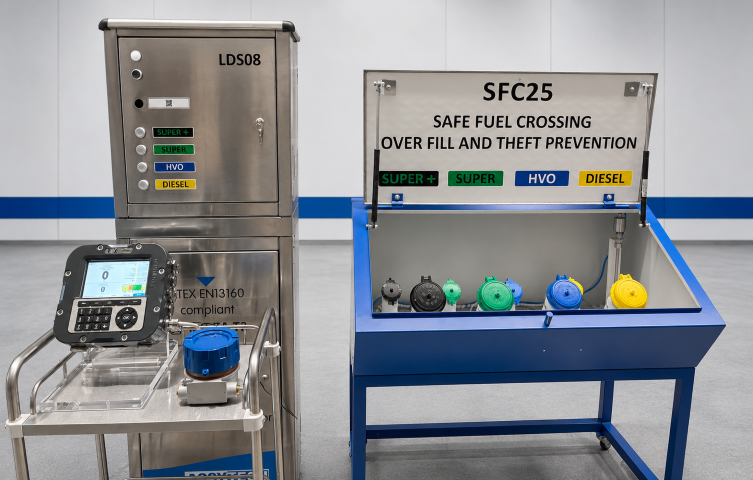
The range of equipment that Assytech unveiled as a new product at UNITI expo is called SFC25. This equipment and these devices are designed to prevent fuel theft and errors in product mixing whilst refuelling tanks at service stations, as well as to prevent spillage during unloading.
Judging by the interest attracted by Assytech’s SFC25 range at the German trade fair, it certainly appears to offer a definitive solution to many of the problems faced by service station owners, particularly at unattended sites.
The system offers four levels of protection, depending on the version and devices used. Its reliability can therefore be increased through the chosen configuration, with further upgrades available as needs arise.
The highest level involves integrating the system with the tanker-mounted discharge meter, which communicates with the system at the service station. If the wrong product is selected, delivery is stopped at the tanker, preventing the fuel from reaching the storage tank.
The SFC25 system also prevents theft: if the cover and vents are opened without authorisation, it triggers an audible alarm. Finally, if overfill protection is installed, the system stops delivery before the fuel overflows, preventing spills.
Let us take a closer look at how SFC25 works through its comprehensive product brochure.
SFC25 as an anti-theft system
Unauthorised opening of a vent activates the flashing beacon and siren. Connected to the leak detection control cabinet, the SFC25 unit can send its operating status and any alarms to the Data Harvest telemetry portal.
Its main components are:
- An automated discharge cap with a coded transducer fitted in the opening lever to detect whether the cap is open or closed and, optionally, identify the associated product type.
- A discharge opening sensor that detects the position of the discharge lever and, optionally, identifies the associated product type.
- A QR code reader paired with the mobile app to identify the type of product to be delivered into the tank.
- A product quality sensor, installed in the filling manifold, that measures the main chemical parameters before unloading. If the readings are incompatible with the selected product, the system prevents the pneumatic valve from opening.
- A pneumatic valve that prevents unloading if the analysed product does not match the reference values.
- An overfill sensor that detects excessive product levels in the tank to prevent spills.
- A stand-alone SFC control panel that manages unloading operations using data from the sensors and activates audible and visual warnings if any anomalies occur.
- A remote siren and flashing beacon that provide audible and visual warnings in the event of an overfill.
- An SFC control panel, installed inside the LDS08 cabinet, that monitors unloading operations and activates alarms if any anomalies occur.
- A product selection interface for tankers: the driver selects the product to be unloaded, and the interface sends this information to the SFC25 system, which checks that it matches the tank that has been opened. If the product does not match, the system prevents unloading.
- An ATEX four-channel TX/RX module that detects the status of the sensors on the automated caps, the overfill sensors and the sump-opening devices, transmitting this information to the SFC25 unit by radio.
- An ATEX junction box in the lower section of the LDS08 cabinet, used to connect all the sensors.
Level 1: the basic solution
The basic solution uses the existing cable ducts connecting the leak detection control unit to the tanks.
The driver presses the button for the fuel to be unloaded. The device then transmits the selected product by radio to the SFC control unit, installed inside Assytech’s LDS08 cabinet. The sump cover for the tank to be filled and the fill cap are then opened. If the product matches the one selected beforehand, unloading is enabled; otherwise, the flashing beacon and alarm siren are activated.
The system checks the cap using a sensor and a lever. When the cap is closed, the lever is folded down along the pipe; to open the cap, the lever must be raised. The sensor detects that the lever has been raised, allowing the system to verify that the correct cap is being opened.
Product selection using push buttons and wiring routed through the cable ducts requires the following components:
- SFC control panel for LDS08 without keypad;
- ATEX LDS08 leak detection control cabinet;
- junction box;
- ATEX flashing beacon;
- siren and flashing beacon for LDS08;
- fill-cap opening sensor;
- 30 cm maximum-level sensor;
- overfill probe;
- tank product level display;
- remote siren and flashing beacon for overfill warnings via a level control relay;
- remote version of the stand-alone SFC control panel.
If product selection uses push buttons and wireless sensors instead, the components are:
- stand-alone SFC control panel without keypad;
- existing LDS08 leak detection control cabinet;
- ATEX junction box;
- tanker radio interface;
- siren and flashing beacon for LDS08;
- fill-cap opening sensor;
- 30 cm maximum-level sensor;
- existing overfill probe;
- tank product level display;
- remote siren and flashing beacon for overfill warnings;
- remote stand-alone SFC control panel.
Level 2: web applications
At Level 2, the product to be unloaded is selected by scanning a special QR code using an app installed on a smartphone or tablet. The operator therefore no longer selects the product manually, providing greater safety.
The driver scans the QR code associated with the vehicle to be unloaded, and the code is sent to the SFC unit. The sump cover for the selected tank and the fill cap are then opened.
If the product matches the one selected beforehand, unloading is authorised. Otherwise, the flashing beacon and siren are activated. If the maximum level is about to be exceeded, the overfill sensor triggers the visual and audible alarm.
Level 3: connection to the tanker
Level 3 establishes communication between the SFC unit and the tanker’s electronic meter through radio transmitters and receivers. This link ensures the correct connection between the tanks.
The electronic meter fitted to the truck is manufactured by Sampi, one of the leading companies in this field. Assytech chose this solution because the meter is widely used and recognised for its high quality and reliability.
At the service station, the driver uses the truck-mounted transmission system to communicate the product to be unloaded to the SFC unit. The tank’s sump cover and fill cap are then opened. If the product matches the selected one, unloading is enabled; otherwise, visual and audible alarms are activated.
If the tanker is not equipped with a radio transmitter, the driver must open the door of the leak detection control cabinet and press the button for the product to be unloaded on the SFC panel.
When the preset maximum level is exceeded, the overfill sensor activates the alarms and stops unloading, if this function is configured on the tanker.
Automatic product selection from the tanker, using wiring routed through the cable ducts, requires the following components:
- SFC control unit for LDS08 with keypad;
- existing LDS08 cabinet;
- tanker radio interface;
- ATEX junction box;
- tanker flashing beacon;
- siren and flashing beacon;
- fill-cap opening sensor;
- 30 cm maximum-level sensor;
- overfill probe;
- tank product level display;
- remote siren and flashing beacon with relay.
Level 4: product quality sensor
Level 4 analyses the product entering the filling manifold, upstream of the pneumatic valve that allows the tank to be filled. This check provides a high level of safety, preventing product mix-ups and quality-related problems.
The driver presses the button for the required product, then opens the tank’s sump cover and fill cap. If the product matches the one selected beforehand, unloading can begin.
A valve temporarily blocks the flow into the tank while the measuring sensor checks the product quality. If the measured values are correct, flow into the tank is allowed; otherwise, the alarms are activated. In this configuration too, exceeding the maximum level activates the flashing beacon and siren.
Assytech has brought all its expertise to the development of the SFC25 system, introducing new solutions to make fuel transfers from tankers to storage tanks even safer. The new system attracted considerable interest in Stuttgart: now we look forward to seeing it in operation.